
FEATURED ARTICLES
France vs Spain Salary Comparison Using PPP Rates
Compare France and Spain salaries using purchasing power parity (PPP). See how price levels, taxes, rent, and benefits affect real salary value.
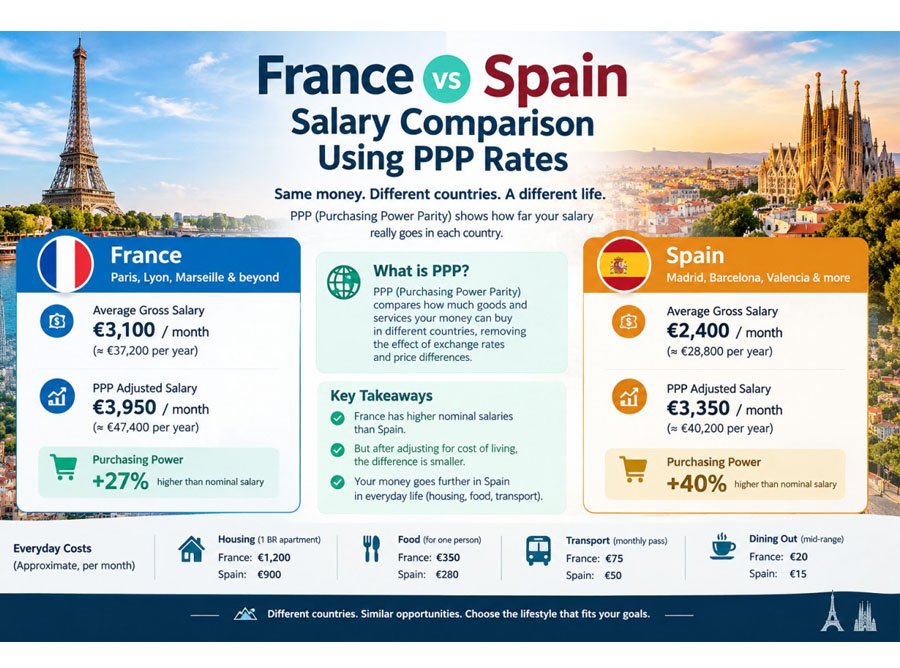
France vs Spain Salary Comparison
Comparing a salary in France with one in Spain is not as simple as comparing two euro amounts. Both countries use the euro, but housing, services, food, transport, and other everyday costs can differ. A France vs Spain salary comparison using purchasing power parity (PPP) gives a better starting point, because it focuses on what your income can actually buy rather than the number printed on your contract.
Purchasing power parity (PPP) adjusts salary comparisons for differences in local price levels. Instead of asking how many euros convert at the market rate, it asks what the salary can actually buy in each country.
PPP is a national-level benchmark, not a personalised net-salary or relocation calculator. Your own outcome will depend on taxes, city, household size, rent, and benefits. Once you have a baseline figure, you can test it yourself using Sharecirculate's PPP Calculator.
What Is Purchasing Power Parity (PPP)
Purchasing power parity is a method for comparing the value of money across countries after accounting for differences in price levels. In plain terms, PPP asks how much of a similar basket of goods and services a salary can buy in France compared with Spain, rather than only comparing euro figures side by side.
The OECD's PPP methodology defines PPPs as currency conversion rates that try to equalise purchasing power by eliminating differences in price levels between countries, based on a shared basket of final consumption goods and services.
This is one of the most important distinctions in this article: PPP is not the same as an exchange rate. Because France and Spain both use the euro, this comparison is not about converting euros into another currency. It is about comparing what those same euros are worth in two different national price environments, shaped by local rent, wages, and taxation on goods such as alcohol, tobacco, and services.
Several concepts sit behind this idea, including price levels, household consumption, nominal salary, and real income. Two institutions, OECD and Eurostat, publish the underlying data that makes this kind of comparison possible.
Quick Answer: France vs Spain Salary Comparison and Purchasing Power
Quick answer: A salary can have different real value in France and Spain even when the nominal amount is identical in euros. PPP adjusts the comparison for national price-level differences, helping you estimate which salary may support a similar basket of goods and services. Your personal result still depends heavily on rent, tax position, household size, and city.
France vs Spain Salary Comparison at a Glance
|
Comparison factor |
France |
Spain |
Why it matters |
|
Currency |
Euro (€) |
Euro (€) |
No currency conversion is required |
|
Salary comparison issue |
Local price levels |
Local price levels |
A euro salary can buy different amounts |
|
PPP use |
Adjusts nominal income for prices |
Adjusts nominal income for prices |
Helps compare broad purchasing power |
|
Tax outcome |
Depends on income and household situation |
Depends on income and personal circumstances |
Gross salary is not take-home pay |
|
Housing impact |
Depends strongly on city and rental market |
Depends strongly on city and rental market |
National PPP cannot replace a rent budget |
Purchasing power is defined in more detail below, and price levels are the mechanism behind it.
Which PPP Measure Should You Use for Salary Comparison?
Not all PPP figures measure the same thing. For comparing what a worker's income may buy, household final consumption or actual individual consumption is generally more relevant than GDP PPP, because these measures focus more directly on consumer goods and services rather than the whole economy.
|
PPP measure |
What it broadly covers |
Use in this article |
|
GDP PPP |
Economy-wide production and spending |
Not the preferred measure for a personal salary comparison |
|
Household final consumption PPP |
Consumer spending by households |
Strong option for comparing everyday spending power |
|
Actual individual consumption PPP |
Goods and services consumed by individuals, including some publicly provided services |
Useful broader living-standard context |
For this article, household-consumption-oriented PPP data are the most practical starting point, since they track the kind of everyday spending, groceries, rent, transport, and services that a salary is actually used for. The OECD publishes annual PPP data across these different measures, and the World Bank maintains a comparable conversion-factor dataset as an alternative source.
How to Calculate a France-Spain Salary Equivalent Using PPP
The basic logic behind a PPP salary comparison is:
Indicative target salary = Source salary × (Target-country price level ÷ Source-country price level)
This formula creates a broad PPP-adjusted estimate. It does not calculate your exact after-tax income, rental costs, social contributions, pension outcome, or employer benefits.
Here is the process in practice:
· Start with the annual gross salary in France or Spain.
· Choose a current, dated price-level or PPP dataset from a reputable source.
· Apply the source-country and target-country figures in the formula above.
· Label the result clearly as an indicative PPP-adjusted estimate, not a guarantee.
· Compare that estimate against expected net pay, rent, transport, insurance, and household costs.
· Use a calculator as your starting benchmark, then validate the number with a personal budget.
To show this with real, dated figures rather than a placeholder example: Eurostat's 2025 household consumption price level index (EU27 average = 100, preliminary release) puts France at 110.3 and Spain at 91.6. On this measure, France's basket of everyday household goods and services sits above the EU average, while Spain's sits below it. Applying the formula above to a €45,000 French salary gives an indicative Spain-equivalent of roughly €37,300 (45,000 × 91.6 ÷ 110.3), a broad estimate of what would be needed in Spain to match the same basket of household spending, before tax, rent, and personal circumstances are factored in.
If you want to run your own numbers rather than doing the maths by hand, Sharecirculate's PPP Salary Calculator will do this for you. Its underlying conversion factors come from World Bank data rather than the Eurostat household consumption index used above, so treat the two as independent, directionally consistent estimates rather than a single unified number.
France vs Spain: What Changes the Real Value of Your Salary?
PPP is only the starting layer. Several other factors decide what a salary is actually worth to you day to day.
Income tax and social contributions: PPP does not calculate your personal tax bill. France uses a progressive income-tax scale that considers household circumstances through the quotient familial system. Spain's withholding and income-tax outcome also depend heavily on individual circumstances and region.
Gross salary versus net salary: Always compare job offers using both gross pay and estimated take-home pay. A larger gross figure does not automatically mean proportionally higher disposable income once contributions and tax are removed.
Housing: National price levels are broad averages. Rent can differ sharply depending on whether you live in Paris, Lyon, Madrid, Barcelona, Valencia, a smaller city, or a rural area.
Employer benefits: Paid leave, pension contributions, health cover, meal vouchers, transport support, bonuses, and relocation assistance can materially change what an offer is really worth.
Household size: A single worker, a couple, and a family with children will not experience the same outcome from the same PPP ratio.
Lifestyle: Frequent travel, private education, car ownership, and dining habits can outweigh national averages entirely.
For the tax mechanics behind these caveats, France's official position is explained on the French tax administration's site, while Spain's Agencia Tributaria sets out IRPF and withholding rules for personal circumstances. Neither France nor Spain's tax outcome can be reduced to a single number without specifying the tax year, salary amount, household status, dependants, region, and employment type involved.
When France May Make Sense, and When Spain May Make Sense
Neither country is a universal winner. The right fit depends on your own numbers.
|
France may be a stronger option when… |
Spain may be a stronger option when… |
|
The French offer includes a substantial salary premium |
The salary difference is modest after adjusting for local costs |
|
The employer provides stronger benefits or relocation support |
You can choose a lower-cost location and retain competitive income |
|
Career progression or sector opportunities justify the move |
Your priority is day-to-day affordability over the highest gross figure |
|
Your estimated net pay and housing budget remain favourable |
Your remote-work or local offer already supports your household budget |
Neither country is universally better for salary value. The better choice is the one that produces the strongest combination of net income, living costs, benefits, career opportunity, and personal lifestyle fit.
Use a PPP Calculator, Then Validate With a Personal Budget
Once you understand the logic above, the fastest next step is to test it with your own numbers. Use Sharecirculate PPP Calculator to create a first France-versus-Spain comparison. Enter your income, choose the source and target countries, and treat the output as a broad purchasing-power benchmark rather than a final figure.
Before accepting an offer or relocating, compare your estimated net pay, rent, utilities, transport, healthcare arrangements, family costs, and employer benefits against that benchmark.
This article provides general financial information and does not replace tax, immigration, employment-law, or personalised financial advice.
FAQ: France vs Spain Salary Comparison and PPP
Is a €40,000 salary in France equal to €40,000 in Spain?
Not necessarily. Both use the euro, but the same amount buys different amounts locally. PPP adjusts for that price gap; your actual outcome also depends on take-home pay, rent, and household size.
What is PPP in a France vs Spain salary comparison?
Purchasing power parity compares salary value after adjusting for local price differences, rather than just comparing euro amounts. The OECD defines it as a conversion rate that equalises purchasing power across countries.
Does PPP include tax?
No. PPP is a purchasing-power benchmark, not a tax calculator. France and Spain have different tax and social-contribution rules, so estimate net salary separately using official tax information.
Does PPP include rent and housing costs?
Only at a broad national level. It won't reflect your specific city or neighbourhood, so build a city-specific rent budget on top of any PPP estimate.
Is it better to live in France or Spain?
There's no universal answer. France tends to suit people prioritising a stronger salary or career progression; Spain tends to suit people prioritising day-to-day affordability. It comes down to your own numbers and priorities.
Is Spain richer than France?
By GDP per capita (PPP-adjusted), France is higher: roughly $66,300 per person versus roughly $57,000 for Spain in 2025 (IMF World Economic Outlook). But France also has higher everyday price levels, so a richer country doesn't automatically mean a given salary stretches further there.
Is 3,000 EUR a good salary in France?
As a monthly gross figure, it's above the SMIC minimum wage (€1,823.03 gross) and above the national median. It typically nets to around €2,300-€2,400/month, comfortable in most regions, tighter in Paris.
Is 70,000 euros a good salary in France?
As an annual gross figure, that's
about €5,800/month, well above the national average (~€3,613/month gross). It's
generally considered a strong salary in France, though comfort still depends on
region and household size.